
Mighty Mule Gate Repair in San Jose: A Homeowner’s Guide
Mighty Mule gate repair in San Jose typically costs $180–$420 depending on whether the issue is electrical, mechanical, or installation-related. Most repairs can be completed same-day if the control board is still functional. If you’d rather not troubleshoot yourself, call Granite Gate Repair California at (888) 416-1369 for a free estimate.
Here’s the thing about Mighty Mule: it’s the most common DIY-installed gate operator in residential California, and that DIY origin story is exactly why so many of them fail. In 14 years of gate work across San Jose, Louis Barrera has found that roughly 60% of Mighty Mule service calls trace back to a bracket angle, battery connection, or limit setting that was off from day one. The product itself isn’t inherently fragile. But it’s designed for homeowners to install, and homeowners don’t always have a torque wrench or a level handy when they’re mounting an actuator arm to a 400-pound gate.
Why Mighty Mule Failures Are Different From Other Brands
Mighty Mule sits in a unique spot in the gate-operator market. Unlike LiftMaster or DoorKing units, which are almost always installed by professionals, Mighty Mule markets heavily to the weekend warrior. That changes everything about how we approach a repair call.
When we service a Mighty Mule in San Jose, we’re not just fixing what’s broken now. We’re often discovering what was never quite right to begin with. A bracket that was “close enough” in 2019 has slowly wallowed out its holes. A solar panel wired in series instead of parallel has been undercharging the battery for three years. The gate still worked, until it suddenly didn’t.
This matters because the repair strategy changes. With a professionally installed Elite or FAAC system, we can usually trust the original mounting geometry and focus on the failed component. With Mighty Mule, we have to verify the foundation before we fix the symptom. Otherwise the new part fails in six months, and the homeowner thinks Mighty Mule is junk. It’s usually not. It’s usually an installation compounding error.
The Three Failure Points We See Constantly
After hundreds of Mighty Mule calls across San Jose and the broader Bay Area, three issues dominate the diagnostic list:
- Battery and solar charging failures. Mighty Mule systems rely heavily on 12V battery power, often supplemented by small solar panels. The battery typically lasts 3–5 years in San Jose’s mild climate, but we’ve seen them cooked in 18 months when a solar regulator fails and overcharges. Corroded terminals are epidemic near the coast, where morning fog salts everything. The system will behave erratically, slow down, or stop mid-cycle, and homeowners often replace the motor when they just need a $45 battery and terminal cleaning.
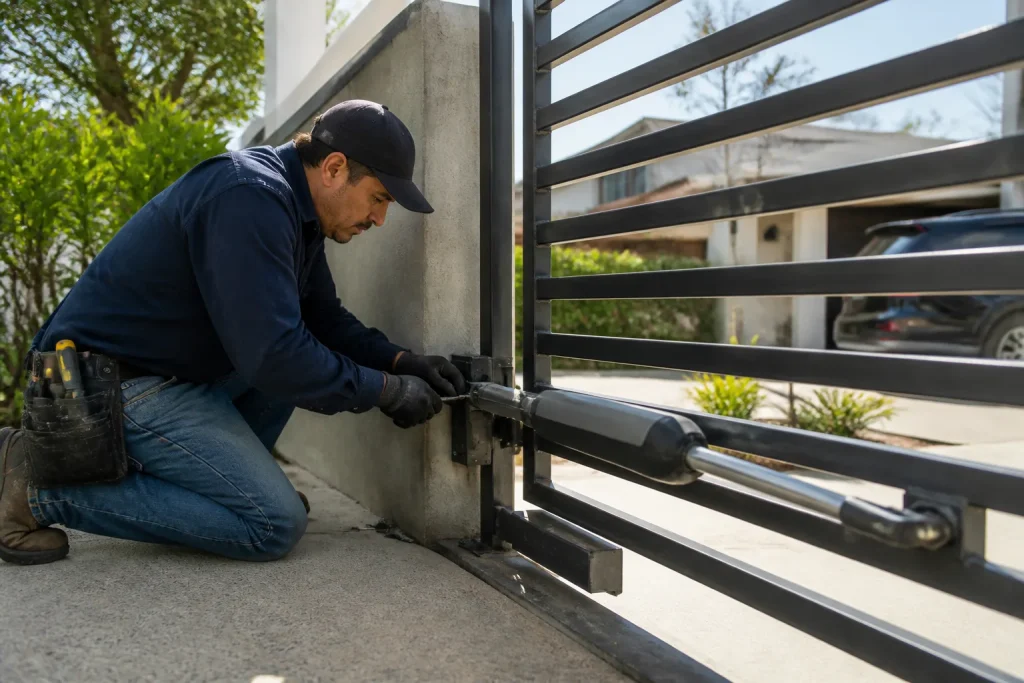
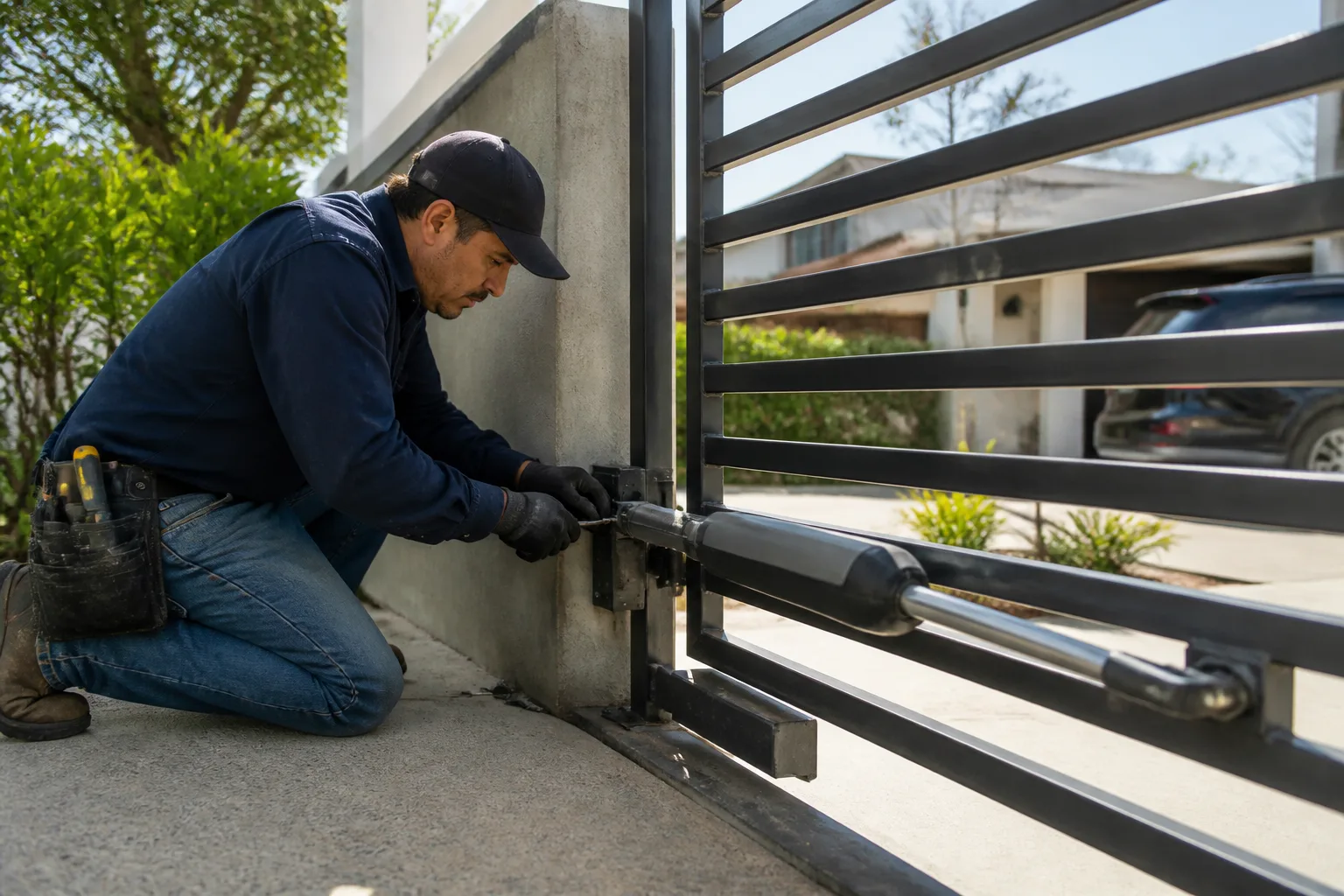
- Actuator arm bracket misalignment. The bracket that connects the Mighty Mule arm to the gate leaf has to be perfectly perpendicular to the gate’s line of travel. Even a 5-degree deviation creates side-load on the actuator, premature gear wear, and eventual seizure. We pulled one out of a garage over in Almaden Valley last month where the bracket had been hand-tightened, worked loose over two years, and finally bent the actuator housing beyond repair. The homeowner thought he needed a whole new system. We welded a new bracket, squared it properly, and replaced just the arm.
- Limit magnet positioning errors. Mighty Mule uses magnetic limit switches to know where the gate is. The magnet has to pass within a precise distance of the sensor, and it has to be on the correct side of the gate. Swapped magnet polarity, incorrect gap distance, or magnet migration due to loose mounting all cause the same symptom: the gate slams open or refuses to close fully. These are software-adjacent problems that look like mechanical failures.
Can This Mighty Mule Be Saved, or Is It Done?
Not every Mighty Mule deserves repair. Knowing the cutoff saves you money and frustration.
The FM200 and FM350 series from the early 2010s are generally at end-of-life if they’ve seen regular use. Control boards for these are increasingly hard to source, and the actuator designs have been superseded twice. If your unit is pre-2015 and the control board is fried, replacement usually makes more sense.
The MM260, MM360, and MM560 lines from roughly 2015–2020 are in a repair sweet spot. Parts are available, the control boards are more robust than earlier generations, and the actuator geometry improved. We’ve successfully extended these units 4–6 years beyond their expected service life with proper bracket correction and component replacement.
Current-generation Mighty Mule units (MM-LPS13, MM-SL2000B, and similar) have better diagnostic LEDs and more forgiving limit setup routines. If yours is under five years old and the control board still responds, repair is almost always viable.
Here’s the threshold question we ask San Jose homeowners: has the gate itself changed since the Mighty Mule was installed? Added wood slats, steel framing, or decorative ironwork can push gate weight past the operator’s rated capacity. A system that was marginal on day one becomes guaranteed failure after a remodel. In those cases, we recommend upgrading to a higher-capacity unit, sometimes from a different brand entirely.
What You Can Safely Check Yourself (and What You Shouldn’t)
We’re not going to pretend every problem requires a service call. There are two safe things any homeowner can verify:
- Battery voltage with a basic multimeter. Disconnect the battery, set your meter to DC volts, and test across the terminals. You’re looking for 12.6V or higher on a charged battery. Below 11.8V, the Mighty Mule control board will start throwing erratic behavior before it throws error codes. Replace the battery, clean the terminals with baking soda and water, dry thoroughly, and reconnect.
- Obvious physical interference. Gate dragging on the ground? Hinge pin walking out? Stop block shifted? These are mechanical problems that masquerade as operator failures. Fix the gate, and the operator often works fine.
What you should not attempt: recalibrating limit switches, adjusting actuator force settings, or opening the control board enclosure to “check for loose wires.” The limit calibration on a Mighty Mule requires specific sequence timing, and incorrect force settings can crush whatever happens to be in the gate’s path. The control board contains capacitors that hold charge even when disconnected. We’ve seen homeowners fry boards with static discharge or miswired jumpers, turning a $200 repair into a $600 replacement.
There’s also the spring tension issue on swing gates. Mighty Mule actuators don’t have the exposed high-tension springs of a garage door system, but the gate itself might. If your swing gate uses a helper spring or torsion assist, that’s genuinely dangerous to adjust without proper tools and training. We recommend calling a professional for any spring-related work.
When Replacement Makes More Sense Than Repair
Even Louis and the Granite Gate team will tell you: sometimes the honest advice is to start over. We evaluate four factors:
- Age and parts availability. If the control board is obsolete and we’re sourcing from eBay salvage, that’s a reliability gamble.
- Gate weight vs. original specification. A Mighty Mule rated for 550 pounds struggling with a gate that now weighs 800 after modifications is a mismatch that repair can’t fix.
- Daily cycle count. Residential Mighty Mule units are engineered for roughly 10–15 cycles per day. A San Jose rental property or multi-tenant driveway pushing 30+ cycles daily needs commercial-grade hardware.
- Cumulative repair history. Two major repairs in 18 months suggests systemic issues, usually installation-related, that will keep generating failures.
When replacement is the right call, we don’t default to another Mighty Mule. We assess the gate, the usage pattern, and the homeowner’s preference for DIY-friendly vs. professionally supported systems. Sometimes that means a LiftMaster with myQ integration. Sometimes it means a Granite Gate Repair California home consultation to walk the options.
What Actually Happens During a Professional Mighty Mule Service Call
Homeowners often assume we’ll show up, swap the obvious broken part, and leave. That’s how general handymen operate. Our process is different, and it’s why our repeat-call rate on Mighty Mule repairs is low.
First, we power down and inspect the full electrical path: transformer output, battery condition, solar regulator function if present, and all terminal connections. Corroded connections get cut back and re-terminated, not just wiggled.
Second, we check mechanical geometry. Gate leaf level? Hinge binding? Bracket squareness? Actuator angle relative to gate travel? We measure, not eyeball. A bracket that’s off by 3 degrees today will be off by 8 degrees in a year as the holes wallow.
Third, we test and recalibrate limits and force settings with the gate under actual load, not just free-swinging. This requires the control board to be in programming mode, which has specific timing sequences that vary by model year.
Fourth, we cycle the gate 10–15 times, varying conditions: battery-only, AC-powered, with and without obstruction testing. Only then do we sign off.
This thoroughness takes longer than a parts-swap, but it prevents the callback. In 14 years of San Jose gate work, we’ve learned that the second visit is always more expensive than doing it right the first time.
Related Services in San Jose
If your gate needs more than a Mighty Mule fix, we handle the full scope. See our Gate Repair in San Marcos page for troubleshooting approaches, Gate Installation in San Marcos for new system design, or Gate Motor & Opener in San Marcos for brand-specific motor service across all nine manufacturers we support.
What happens when you call
- 1
A real person answersNo phone trees — you reach a local pro.
- 2
You get an upfront price rangeHonest numbers before anyone is dispatched.
- 3
A background-checked tech heads outLicensed & insured, dispatched right away.
- 4
You approve before work beginsNothing starts until you say go.
The Bottom Line
Mighty Mule systems can be reliable when installed correctly and serviced thoroughly. Most “Mighty Mule problems” are actually installation problems that took years to manifest. The brand’s DIY-friendly design is its greatest strength and its biggest weakness.
Key takeaways:
- Check your battery voltage and physical gate condition before assuming the operator failed
- Bracket alignment and limit magnet positioning are the hidden causes behind most “random” failures
- Pre-2015 units with dead control boards usually aren’t worth saving
- Never open the control board or adjust force settings without proper training
- A professional diagnostic checks the full system, not just the broken part
If you’re in San Jose and your Mighty Mule is acting up, Granite Gate Repair California offers free estimates. We’ve diagnosed these systems across Willow Glen, Almaden, Berryessa, and everywhere between. Call (888) 416-1369 and we’ll get you back in motion.
Frequently Asked Questions
Most Mighty Mule repairs in San Jose run $180–$420. Battery and terminal service sits at the low end. Actuator replacement with bracket correction runs higher. Control board replacement is typically $350–$600 depending on model generation. Call (888) 416-1369 for an exact quote, estimates are free.
You can safely check battery voltage with a multimeter and clear physical obstructions. Beyond that, limit switch recalibration, force setting adjustment, and any control board work requires brand-specific knowledge and tools. Incorrect force settings create a crushing hazard, and control board capacitors hold charge even when unplugged. We recommend professional service for anything beyond basic battery and obstruction checks.
This usually indicates a limit magnet or safety sensor issue, not a motor failure. The close-limit magnet may have shifted, the photo-eye or edge sensor may be misaligned or obstructed, or the control board may not be receiving the “all clear” signal. Check for spider webs across photo-eyes and verify the magnet hasn’t migrated from its mount. If those look correct, the issue likely requires limit recalibration.
Replace if the unit is pre-2015 with a failed control board, if the gate weight now exceeds the operator’s rating, or if you’ve had two major repairs in 18 months. Repair if the control board still responds, the unit is under five years old, and the gate geometry is correctable. A professional assessment weighs these factors against replacement options that might better serve your current usage.
Written by Louis Barrera, Founder & Master Technician at Granite Gate Repair California, serving San Jose since 2012.
Need Gate Repair Help?
Call Granite Gate Repair California — licensed & insured, here with fast after-hours help in California.
(888) 416-1369