FAAC Gate Repair in San Jose: A Homeowner’s Guide
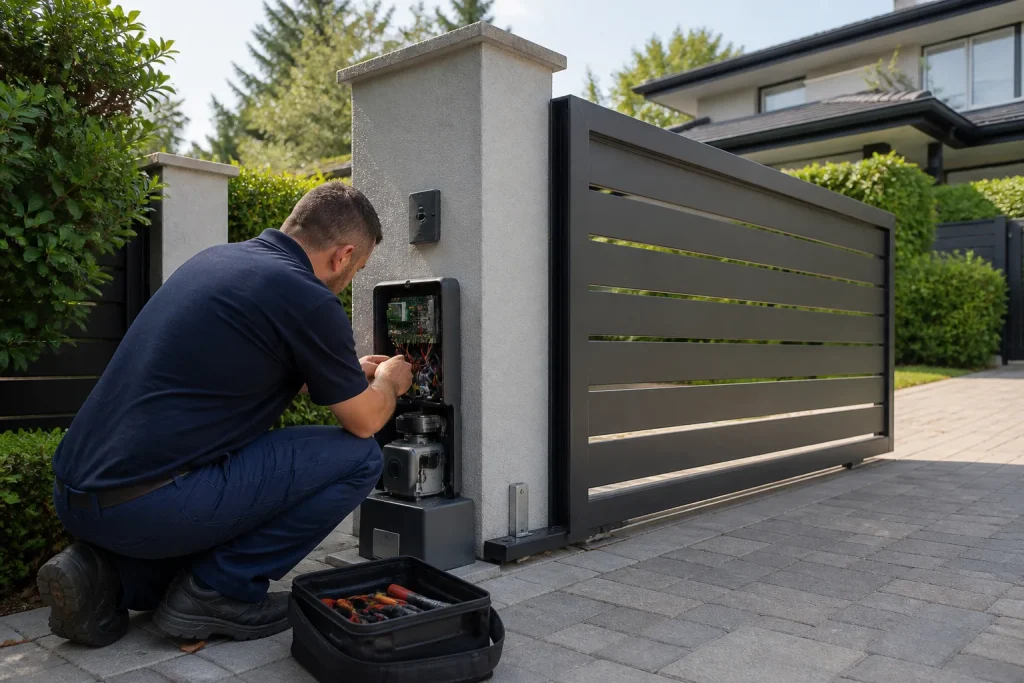
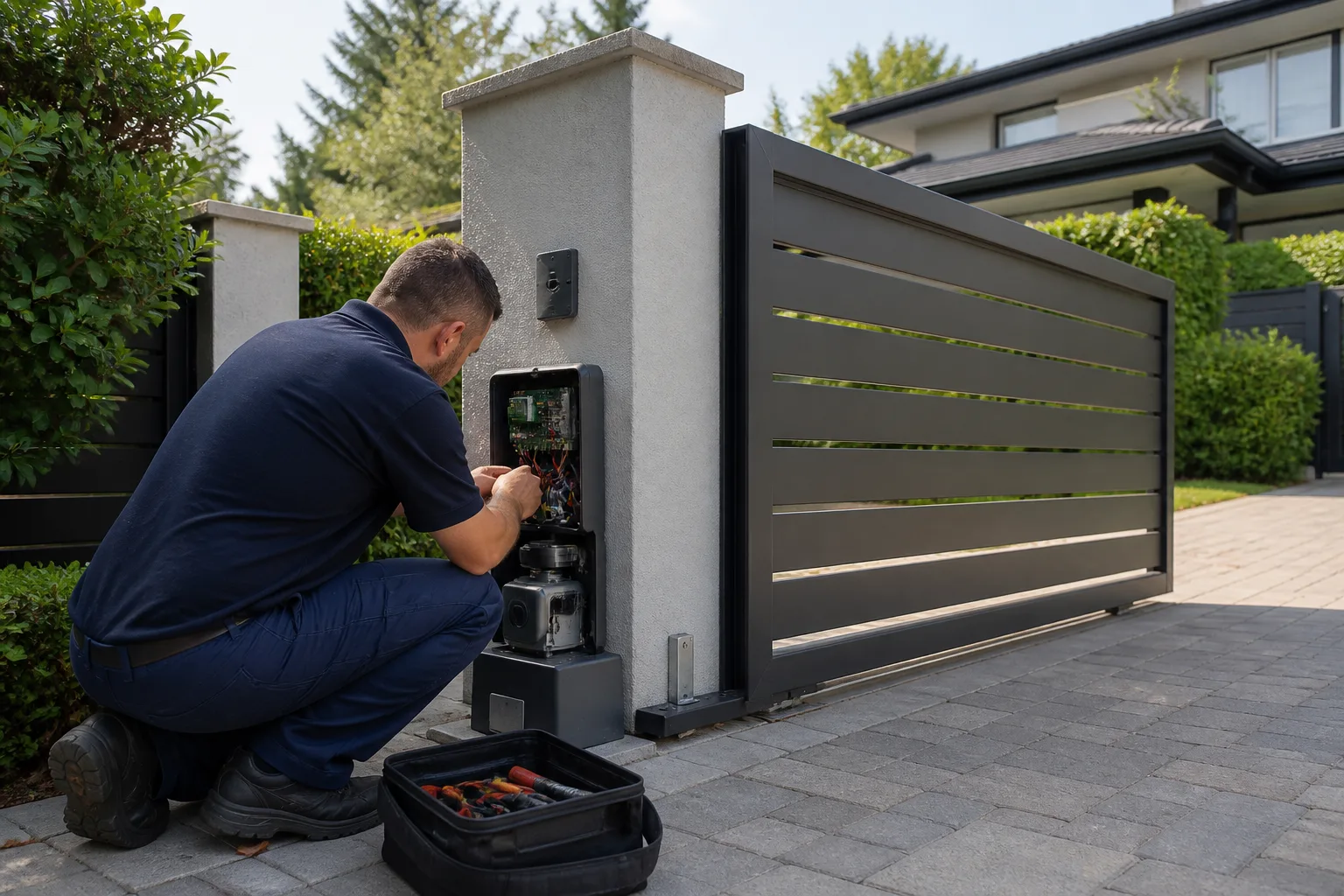
FAAC gate repair in San Jose typically involves troubleshooting Italian-engineered hydraulic operators, proprietary DECODER programming, and control boards that most residential technicians haven’t trained on. Expect repair costs between $280 and $650 depending on whether you’re dealing with a seal replacement, control board issue, or underground operator service. If your gate is moving slowly, drifting from its stop position, or leaking fluid near the operator, you’re likely looking at hydraulic system work that requires brand-specific expertise rather than generic gate repair.
If that sounds like more than you want to figure out alone, Granite Gate Repair California offers free estimates — call (888) 416-1369 and we’ll diagnose it properly the first time.
Why FAAC Gates Fail Differently Than Domestic Brands
Most gate repair calls we get in San Jose involve electromechanical operators from brands like LiftMaster or Linear. The motor hums, the chain breaks, the limit switch fails — straightforward stuff. FAAC doesn’t play by those rules.
FAAC’s 400-series hydraulic operators will run 500,000 cycles without complaint — until one seal fails, the fluid level drops, and a technician who’s never seen a hydraulic gate operator replaces the motor instead of the $45 seal kit. We’ve been called out to jobs in Willow Glen where the previous company charged for a full motor replacement when the real problem was a weeping hydraulic fitting that took twenty minutes to swap.
Hydraulic failures present three distinct symptoms that electromechanical operators don’t:
- Slow operation across all cycles, not just under load — this usually means low fluid or a failing pump
- Position drift, where the gate stops short or overshoots its limit by increasing amounts — air in the hydraulic lines or worn position sensors
- Fluid leakage near the operator base, often mistaken for water or grease by inexperienced technicians
The hydraulic principle itself is simple: an electric motor drives a pump, pressurized fluid moves a piston, and the piston pushes your gate. But the tolerances are tight, the fluid is specialized, and bleeding air from the system requires FAAC-specific procedure. In our 14 years working gates across San Jose, we’ve found that maybe one in ten local technicians has actually opened a FAAC hydraulic unit.
The DECODER System: Where Good Intentions Go Wrong
FAAC’s DECODER rolling-code system is elegant when it works and brutal when it doesn’t. Unlike standard dip-switch or learn-button receivers, DECODER uses address-based programming where each remote, keypad, or loop detector gets assigned a specific address in the control board’s memory map.
Here’s where homeowners and generalist technicians get into trouble. Someone decides the receiver is “probably bad” and swaps in a generic replacement. Now nothing works. Not because the new receiver is defective, but because the addresses weren’t migrated, or worse, because the new unit doesn’t speak DECODER at all.
We’ve rescued systems in Almaden Valley where a handyman replaced the receiver, then the control board, then started on the loop detector — $800 in unnecessary parts because nobody checked whether the original receiver just needed its antenna repositioned or its address table reloaded.
If your FAAC gate in San Jose stops responding to remotes but still works from the manual release or hardwired button, the receiver or its antenna is suspect. Before anyone replaces hardware, they should verify antenna continuity, check for address corruption (often caused by power surges), and confirm the decoder version matches your remote generation. DECODER Classic, DECODER 2, and DECODER 3 aren’t backward compatible.
Reading FAAC Control Boards: E024S and E1D Diagnostics
The E024S and E1D control boards are the brains of most residential FAAC systems we see in San Jose. Both boards flash error codes through LED sequences, but the manuals are translated from Italian and tend to describe symptoms in ways that don’t match American gate terminology.
Common error patterns and what they actually mean:
- One flash, pause, repeat: Safety device active — check photocells, edges, or loop detector. Often just misaligned photo eyes after a bump from a garbage bin.
- Two flashes: Motor overload or thermal protection — on hydraulic units, this usually means the pump is working too hard due to low fluid or a mechanical bind, not a bad motor.
- Three flashes: Encoder or position sensor fault — the board doesn’t know where the gate is. Common after manual release if the gate was moved with power off.
- Four flashes: Power supply anomaly — check incoming voltage, transformer, and especially the capacitor bank. Capacitors age faster in San Jose’s summer heat.
The expensive mistake we see repeatedly: board replacement before addressing wiring or power supply issues. A failing 24V transformer causes erratic behavior that looks like a bad board. A single pinched low-voltage wire can trigger safety faults that mimic encoder failure. We’ve saved customers in Cambrian Park hundreds by tracing a fault to a $12 transformer instead of the $340 control board another company quoted.
When a technician proposes board replacement, ask what specific error code they read, what voltage they measured at the board terminals, and whether they’ve load-tested the transformer. If they can’t answer, get a second opinion.
Underground Operators: The FAAC D600 and D1000 Series
FAAC’s underground operators, the D600 for swing gates and D1000 for heavier applications, are beautiful engineering until they need service. Buried in a foundation box below grade, they’re invisible when working and nearly inaccessible when they aren’t.
San Jose’s climate creates specific challenges for these units. Our clay-heavy soils in neighborhoods like Berryessa and parts of Evergreen hold moisture longer than the sandy soils where these operators were originally designed. Water infiltration into the foundation box corrodes the hydraulic cylinder, damages the position encoder, and eventually fries the control connections. We’ve pulled D-series units out of boxes that were half full of water because the drainage failed or the box seal degraded.
Required service intervals that most homeowners miss:
- Annual: Drain and inspect the foundation box, check seals, verify drainage path is clear
- Every 2–3 years: Hydraulic fluid analysis for water contamination and viscosity breakdown
- Every 5 years or 300,000 cycles: Seal kit replacement as preventive maintenance — much cheaper than emergency service when the cylinder fails
Access is the other issue. The foundation box lid is often concreted over, landscaped around, or paved up to. We’ve spent two hours on excavation before touching a single bolt. If you’re considering a D-series installation in San Jose, demand a foundation box with a proper drainage plan and a lid that future technicians can actually open.
What to Ask Before Authorizing Any FAAC Repair
Not every gate company that advertises “all brands” has actually worked on FAAC. The proprietary hydraulic systems, Italian control logic, and parts availability create a barrier that filters out generalists. Before you authorize repair, ask three specific questions:
- “How many FAAC hydraulic operators have you serviced this year?” If the answer is vague or they pivot to “we work on all major brands,” that’s your signal. We’ve serviced FAAC alongside Viking, DoorKing, and Ghost Controls systems — enough to know the differences matter.
- “Do you carry seal kits and hydraulic fluid, or do you need to order them?” A technician without FAAC-specific parts on the truck is guessing at the diagnosis. We stock common FAAC seal kits, O-ring assortments, and the correct hydraulic fluid because we’ve learned that “we’ll order it” means a second trip and more downtime.
- “Can you source FAAC control boards, or are you proposing a generic replacement?” Some companies will try to retrofit a domestic board into a FAAC system. It can work, badly, with compromised functionality. We source genuine FAAC electronics or explain exactly why and how we’re adapting if OEM isn’t available.
Related services in San Jose: If you’re comparing options or need a full system evaluation, see our gate repair, installation, or motor and opener pages for what’s involved in broader gate work.
When to call a pro: If your FAAC gate shows hydraulic leakage, has stopped responding to remotes after any electrical work, or makes grinding noises during operation, stop cycling it. Forced operation can destroy a recoverable pump or damage the mechanical gate structure. We’ve seen a $200 seal job turn into a $1,200 rebuild because the homeowner kept running the gate on low fluid.
The Bottom Line
FAAC gates reward proper diagnosis and punish guesswork. The hydraulic platform, DECODER programming, and underground installation options create a system that’s robust when maintained by someone who understands it, expensive when treated like a generic operator.
Key takeaways for San Jose homeowners:
- Hydraulic symptoms (slow, drifting, leaking) need hydraulic expertise, not motor replacement
- DECODER receiver issues are programming problems first, hardware problems second
- Control board error codes have specific meanings — demand the code, not just the part replacement
- Underground operators need drainage maintenance that our local soil conditions make essential
- Brand-specific experience matters more than “we fix gates” marketing
Granite Gate Repair California has diagnosed and repaired FAAC systems across San Jose for 14 years. We carry the parts, we’ve opened the hydraulics, and we won’t experiment on your gate to learn the brand. If you’re dealing with a FAAC operator that isn’t behaving, call (888) 416-1369 for a free estimate. We’ll tell you what’s actually wrong before any work starts.
Frequently Asked Questions
Most FAAC repairs in San Jose run between $280 and $650. Seal kit replacement on a 400-series hydraulic operator typically falls at the lower end, around $280–$380. Control board replacement with proper diagnostics runs $450–$650. Underground D-series service costs more due to access labor, often $500–$900 depending on excavation needs. Call (888) 416-1369 for an exact quote — estimates are free.
Technically anyone can attempt it, but most can’t do it correctly. FAAC’s hydraulic systems, DECODER programming, and Italian control logic require specific training and parts access that generalist gate companies often lack. Ask directly about their FAAC experience and whether they stock hydraulic seal kits before authorizing work. If they don’t have confident, specific answers, keep looking.
Slow operation on a FAAC hydraulic gate almost always indicates low hydraulic fluid, a worn pump, or air in the system — not a failing motor. Unlike electromechanical operators where slow movement often means motor wear, hydraulic slowness is a fluid pressure problem. Don’t let a technician sell you a motor replacement without checking fluid level and pressure first.
If the gate structure and installation are sound, repairing a FAAC operator is usually more cost-effective than full replacement, especially for hydraulic units that outlast most electromechanical alternatives. Replacement becomes worth considering if you’re facing multiple simultaneous failures, parts obsolescence, or if you want to switch to a brand with broader local service availability. We can evaluate either path — call (888) 416-1369 and we’ll give you honest numbers for both options.
Written by Louis Barrera, Founder & Master Technician at Granite Gate Repair California, serving San Jose since 2012.
Need Gate Repair Help?
Call Granite Gate Repair California — licensed & insured, here with fast after-hours help in California.
(888) 416-1369